The woman who walked in was in her sixties, with silver hair cut short and reading glasses pushed up on her head.
She carried a leather document case under one arm and walked like someone who had been in rooms like this before and found them unimpressive.
She stopped inside the ballroom doorway and looked at Alonzo.
“I came as quickly as I could,” she said.
“Is she here?”
“She’s here,” Alonzo said.
The woman looked at Renata.
Her expression shifted — professional composure giving way for just a moment to something warmer.
“Renata,” she said.
“My name is Sylvia Crane.
I’m a family law attorney.
Alonzo contacted me eight months ago.
I’ve been building your case since then.”
Renata looked at Alonzo.
“Eight months ago.”
“I didn’t know where you were,” he said.
“But I knew something was wrong.
I started with what I could prove.”
Renata was quiet for a moment.
Then she said, “Maisie.
I need to see Maisie.”
Flora brought Maisie forward from the edge of the room.
The little girl walked carefully, watching the floor, still holding one hand against her cheek.
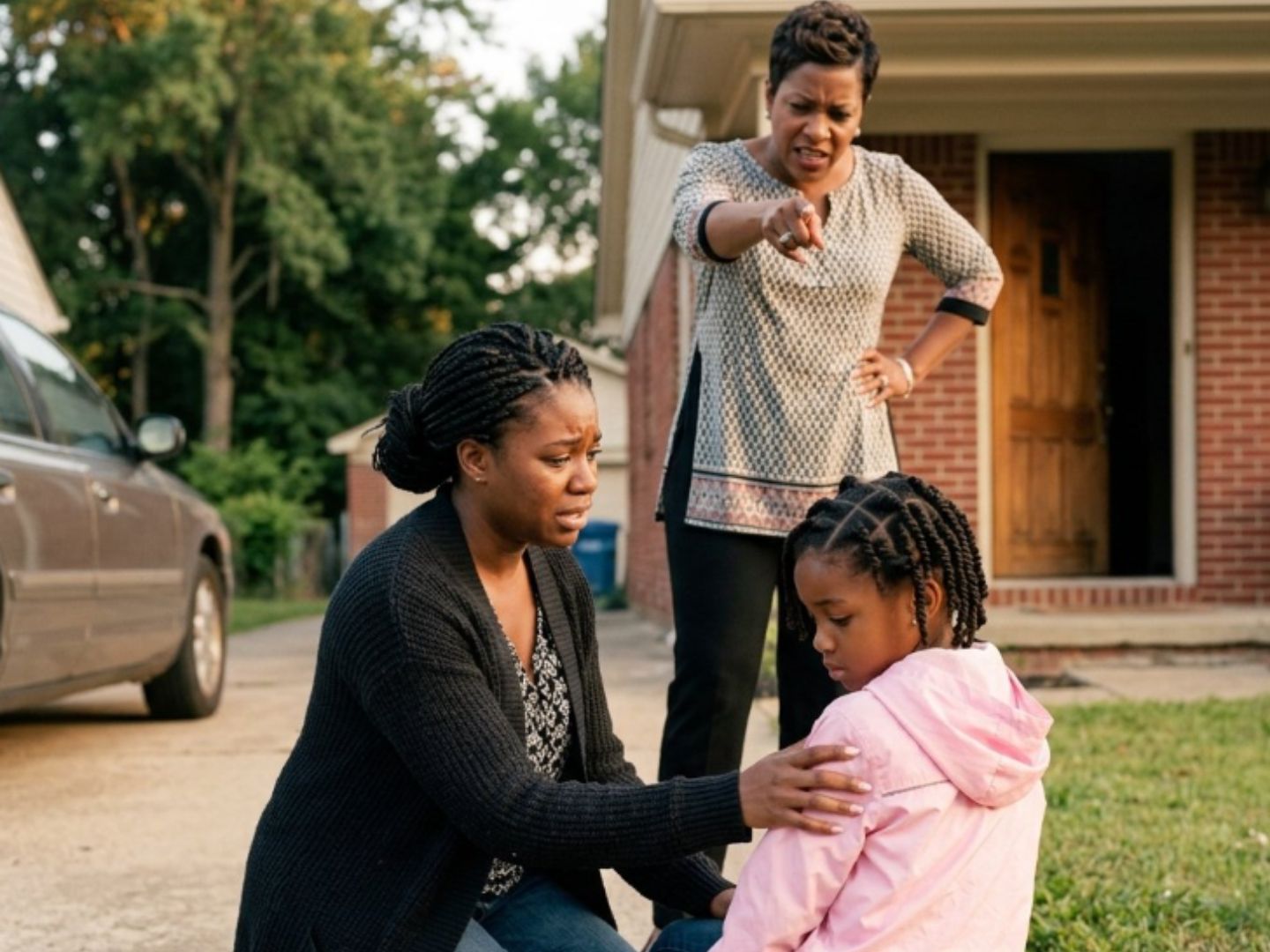
Renata crouched down in front of her.
Maisie looked at her.
Children are not always surprised by the things that devastate adults.
She studied Renata’s face with the serious attention of someone trying to place a half-remembered dream.
“You look like the picture,” Maisie said.
Renata’s breath caught.
“What picture?”
“The one Flora keeps.
In the kitchen drawer.
She showed me once.
She said it was someone who loved me very much.” Maisie glanced back at Flora.
“She made me promise not to tell.”
Flora pressed her hands over her mouth.
Her shoulders shook once, silently.
Renata pulled Maisie gently toward her and held her.
Maisie, after a moment, held back.
Portia watched from her chair.
Her lawyer had arrived and was standing beside her now, speaking quietly into her ear.
Portia was not listening to him.
She was watching Renata and Maisie.
“This changes nothing legally,” Portia said.
Loud enough to be heard.
“Whatever document you’ve produced, whatever story she’s told — I am still this child’s legal guardian.
I have been for three years.
The courts will—”
“The courts will review the forged restraining order,” Sylvia Crane said, without looking up from her document case.
“They will review the circumstances under which guardianship was transferred.
They will review the testimony of at least four witnesses currently in this room.” She snapped the case open.
“And they will review this.”
She held up a thick folder.
“Three years of documented contact attempts by Renata.
Letters returned unopened.
Phone numbers that were disconnected.
A visit to this address fourteen months ago that was turned away at the gate by your staff.” Sylvia set the folder on the nearest table.
“She did not disappear.
She was kept out.”
Portia’s lawyer put a hand on her arm.
She shook it off.
“You think you’ve won something today,” Portia said.
Her voice was very controlled.
“You haven’t.
I have resources you haven’t touched.
I have relationships in this city that go back forty years.
I will tie this up in proceedings for as long as it takes, and in the meantime that child stays with me, in the home she knows, in the life I built for her—”
“The life you built,” Alonzo said.
“Yes.”
“On what foundation, Portia?”
She didn’t answer.
“You took a child from her mother.
You forged legal documents.
You paid someone to keep Renata isolated for three years.
You sl\*pped a seven-year-old girl across the face in front of a hundred people tonight because she knocked over a vase.” He paused.
“That is the foundation.
That is what you built.”
Portia’s jaw tightened.
“I raised that child when her mother ran away.”
“Her mother didn’t run,” Maisie said.
The room went very still.
Maisie had pulled back from Renata and was standing straight, looking at Portia with the clear, uncomplicated gaze of a child who has just decided to say the thing she has been thinking for a long time.
“She didn’t run,” Maisie said again.
“I always knew she didn’t run.
You told me she did.
But mamas don’t run.
Mine didn’t.”
Portia opened her mouth.
Closed it.
Alonzo looked at his daughter and felt something move through him that had no name and needed none.
Portia’s lawyer leaned in again.
This time she listened.
Her eyes went to the folder on the table.
Then to Sylvia Crane.
Then to the two men who had brought the document.
Then to the bodyguards.
She picked up her bag from the floor beside her chair.
“This conversation is over,” she said.
“My lawyer will be in contact.”
“Portia.” Alonzo’s voice stopped her.
“If you walk out of this room and begin what you’re planning to begin — the proceedings, the delays, the resources you mentioned — I will make certain that every document in that folder, including the forged restraining order, is in the hands of the district attorney by Monday morning.” He held her gaze.
“You can fight me in family court.
Or you can face a crjminal inquiry.
Choose carefully.”
Portia stood very still.
Her lawyer said something quietly.
She didn’t move for a long moment.
Then she walked toward the door.
She stopped just before it.
“I did love that child,” she said.
She didn’t turn around.
“Whatever you believe, I did love her.”
She walked out.
The door did not slam.
It closed with a soft, definitive click.
Cedric let out a long breath from across the room.
He looked at Renata, then at Maisie, then at his own hands on the table.
“I owe you an apology,” he said to Renata.
“A real one.
Not tonight.
But soon.”
“I know,” Renata said.
Maisie reached up and took Renata’s hand.
Outside, through the tall ballroom windows, headlights swept across the gravel drive as a car pulled away.
Sylvia Crane closed her document case and looked at Alonzo.
“She’ll lawyer up fully by tomorrow morning,” she said.
“We need to move fast.”
“I know,” Alonzo said.
“What do we need first?”
“The witnesses in this room.
Signed statements.
Tonight if possible.”
Alonzo looked around at the guests — people who had come for a wedding and stayed for something else entirely.
Not one of them moved toward the door.