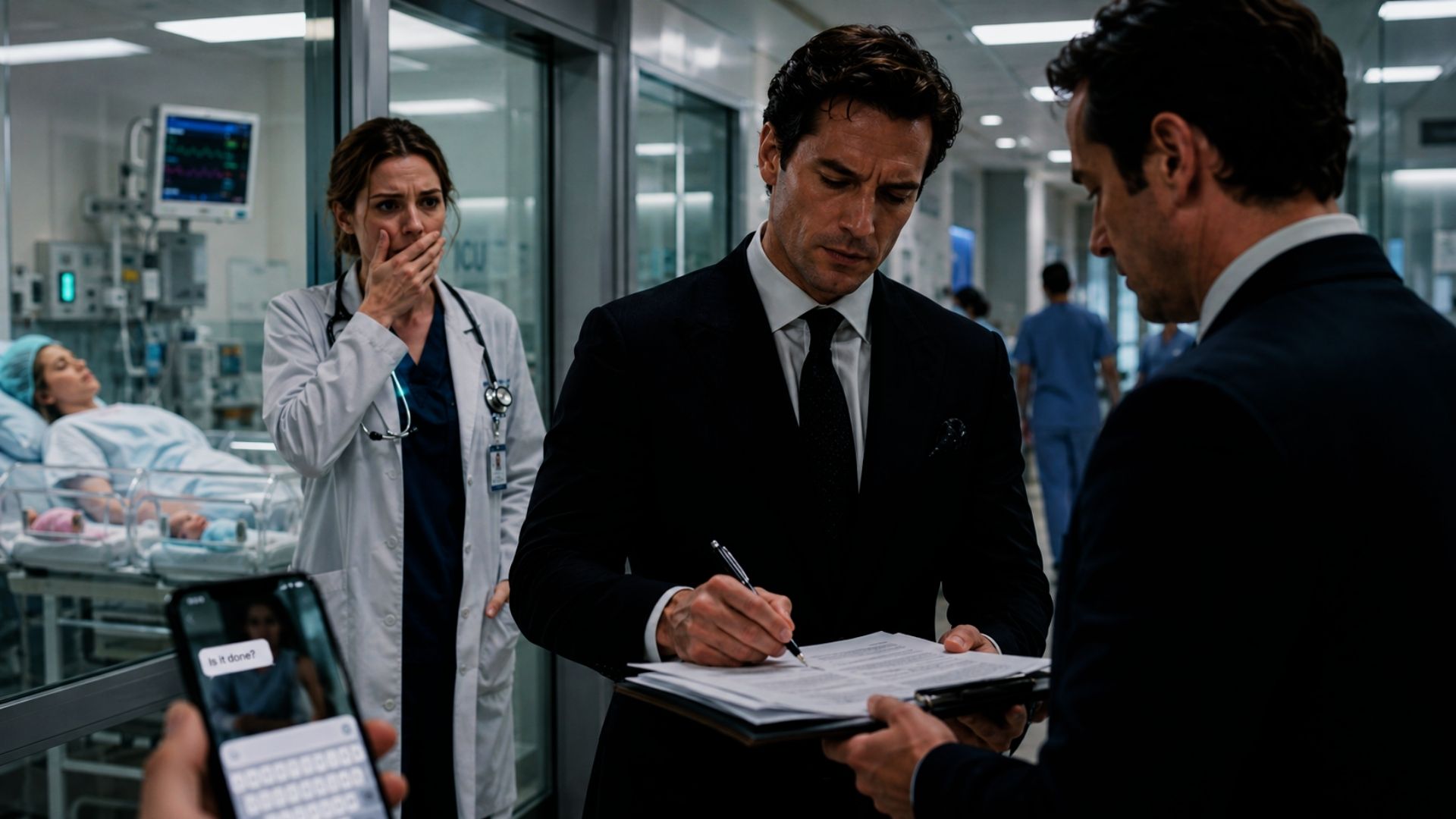
His name was Gerald Marsh.
He had worked for the Vance family for twenty-two years.
He had drafted trusts, closed acquisitions, buried inconvenient details in footnotes that no one ever read.
He was Flynn’s instrument — careful, expensive, and loyal to whoever signed his retainer.
Or so Flynn had believed.
Gerald arrived at the hospital that afternoon carrying a slim leather briefcase and a look on his face I had never seen from any Vance associate before.
Discomfort.
He sat down across from me in the small family consultation room.
The twins were two floors up in the NICU.
I hadn’t been allowed to hold them yet.
That fact alone had kept me from falling apart — there was no room for collapse when my children still needed someone to fight for them.
“Mrs.
Vance,” Gerald began.
“You can call me Nora,” I said.
“I assume my name has been removed from everything else.
You may as well use it.”
He set the briefcase on the table but didn’t open it yet.
“I owe you an explanation,” he said.
“And possibly an apology.”
“Start with the explanation.”
Gerald folded his hands.
“Six months ago, Flynn came to me with a request.
He wanted to amend the original Vance Family Trust — specifically the medical vulnerability clause his grandfather had written in 1987.
He said it was outdated.
He said it created unnecessary exposure.”
“He wanted it gone before the babies came.”
“Yes.”
“And you drafted the amendment.”
“I did.” Gerald didn’t look away.
“What I did not do was verify the witness signature before filing.
My assistant handled that step.
The witness Flynn provided was his personal driver.”
I waited.
“The trust requires an independent witness with no financial relationship to either party.
His driver receives a salary from Vance Holdings.” Gerald opened the briefcase and placed a single document on the table.
“The amendment is void.
It has been void since the day it was filed.
I only discovered the error last week when Flynn instructed me to begin transferring assets.”
“He’s already trying to move assets.”
“He was.” Gerald’s voice dropped slightly.
“I stopped the process when I identified the problem.
Flynn does not yet know I stopped it.
He believes the transfers are pending standard processing delays.”
I looked at the document on the table.
The void amendment.
Flynn’s careful plan with a single fatal flaw buried inside it.
“Why are you telling me this?” I asked.
Gerald was quiet for a moment.
“I have a daughter,” he said.
“She’s thirty-one.
She had her first child eight months ago.” He paused.
“When I heard what happened in that hallway — what Flynn said to the doctor — I went home that evening and I sat in my car for a long time.”
The room was very still.
“I am not a good man, Mrs.
Vance.
I have done a great many things for the Vance family that I am not proud of.
But I am not willing to do this one.”
I picked up the void amendment.
My hands were steadier than I expected.
“What does the original clause actually give me?” I asked.
“Full beneficial ownership of the Vance Family Trust.
All holdings, all accounts, all real property held under the trust structure.” Gerald paused.
“Approximately four hundred and thirty million dollars in total assets.”
The number sat between us like something physical.
“Flynn doesn’t know yet,” I said.
“No.
But he will very soon.
He has a board meeting Thursday.
When the asset transfers don’t appear in the system, he’ll start asking questions.” Gerald closed the briefcase.
“You have perhaps seventy-two hours before he understands what has happened.”
He stood to leave.
“Mrs.
Vance,” he said at the door.
“You should find your own attorney.
Today, if possible.
Someone Flynn has never met and cannot reach.”
He left.
I sat alone in that small room for exactly forty seconds.
Then I picked up my phone and called the one person I trusted completely — my older sister, Diane, who had spent the last decade as a forensic accountant for a firm in Boston.
She answered on the second ring.
“Nora.
How are you?
How are the babies?”
“I need you to come,” I said.
“And I need you to bring someone who knows trust law.”
A pause.
“How bad is it?”
I looked at the void amendment still in my hand.
“Flynn made a mistake,” I said.
“A very large one.
And I have about seventy-two hours before he figures out what it is.”
Diane didn’t ask another question.
“I’ll be there by morning,” she said.
I set the phone down.
Somewhere two floors above me, my twins were breathing in small, careful rhythms under warming lights, waiting for a mother who was still alive.
Flynn had been so certain he’d removed every obstacle.
He had forgotten that the most dangerous thing in the world is a woman who has nothing left to lose — and everything left to protect.
My phone lit up on the table.
A text from an unknown number.
Four words:
*He knows about Gerald.*