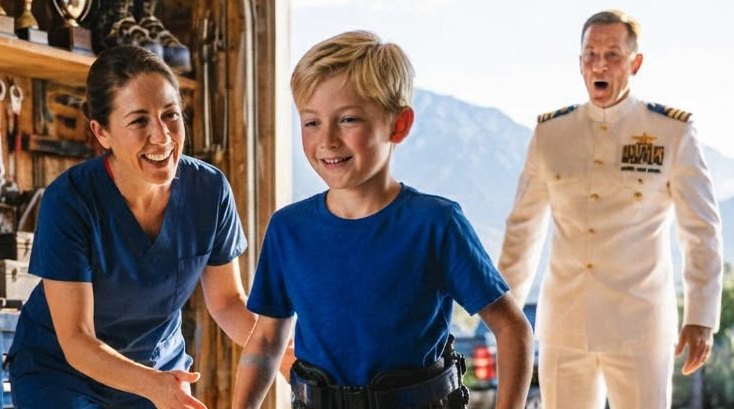
👇 FULL STORY BELOW
Chapter 8: “So we can prove it’s Halcyon’s?”
“So we can prove it’s Halcyon’s?”
“We can prove the hardware matches their specifications. But that’s not enough for a court.”
“What do you need?”
Dana swiveled her screen to face us.
“A remote command. If we can trigger that modem to transmit a real-time data packet, we can capture the handshake with their servers. That’s the smoking gun.”
“So we need to power the device and walk it?”
“No.” Dana looked at me. “We need to wear it.”
Silence.
“Owen needs to be wearing it for a full biometric stream,” she said. “That means either you put the exoskeleton back on a child—or you find a way to simulate an adult body using it.”
I looked at the X9, still sealed in its bin.
“How much time do you need?”
“Twenty-four hours. Maybe thirty.
“Then it’s waiting.”
—
The plan came together in a day.
Dana built a custom adapter harness that let me wear the X9 without Owen’s delicate frame. It looked ridiculous—a grown woman in a pediatric exoskeleton, the knee joints aligned to my longer legs with PVC extenders.
But the sensors didn’t care about aesthetics. They responded to weight and movement.
“This looks absurd,” I muttered.
“Your sacrifice is noted,” Dana said. “Now walk.”
I took my first step.
The X9 hummed. The actuators engaged smoothly.
Then the left knee clicked.
I stopped.
“Walk through it,” Dana said.
“Owen couldn’t. It locked.”
“That was under load with a child’s lower body weight. Your adult weight will trigger a different torque response.”
“Are you telling me this thing might not lock for a hundred-and-forty-pound adult?”
Dana’s expression darkened.
“That’s exactly what I’m telling you. If it doesn’t lock for you, then the defect isn’t a load failure. It’s intentionally calibrated to fail only under Owen’s weight.”
I stared at her.
“Which means somebody programmed this device to hurt a specific child.”
—
I walked for six hours.
The X9 didn’t lock once.
Dana captured hundreds of transmission packets, all sent to Halcyon’s servers.
“I have enough for three warrants,” she said finally. “This is beyond a product defect. This is premeditated endangerment.”
Nathan arrived with a fuming expression.
He handed me a letter.
“What’s this?”
“A notice from StrideCore’s legal team. They’re suing me for breach of confidentiality. Victor filed it this morning.”
“He’s escalating.”
“He’s panicking.”
I read the letter. “They’re demanding the device be returned within 48 hours or they’ll seize it as company property.”
“That’s what I said.”
I looked at the X9, still strapped to my legs.
“Then we don’t give them the device back. We give them a recording of it.”
Dana was already pulling up the data.
“I’ll compile everything into a forensic package,” she said. “Federal prosecutors love a clean chain of custody.”
I peeled off the exoskeleton and set it on the workbench.
The machine looked so innocent in the dim light. A high-tech pair of legs, waiting for a child who didn’t trust it anymore.
“Owen will walk,” I said. “But it won’t be this machine.”
I pulled out my sketchbook and opened to the final page.
The simple brace. Carbon fiber. Aluminum. Adjustable tension bands.
No modem. No software. No hidden eyes.
“Exactly,” Nathan said quietly. “It’s time we gave him something better.”
—
I spent the next week in the workshop, building Owen’s new braces from scratch.
Nathan watched me work, handing tools when I asked.
“You never told me,” he said one evening. “About your commanding officer.”
“Not much to tell. He was a good man. He saw me crawl a hundred yards with a tourniquet and decided I deserved a medal, not a court-martial.”
“Victor found a lawsuit?”
“An investigation. No charges. But in the military, suspicion is enough to end a career.”
I looked up.
“I left because I wanted to help children heal. Not because I was guilty of anything.”
Nathan nodded slowly.
“I know,” he said. “You proved that when you caught Owen before he hit the floor. No one who builds a brace in her free time for a patient she’s not even related to is guilty of anything.”
—
On the eighth day, the braces were ready.
I drove to Nathan’s house. Owen was sitting on the couch, watching TV.
“Good morning,” I said.
“Hi, Lauren.”
“I have something for you.”
I eased into the room carrying a carbon fiber case. Owen held his breath while I opened it.
“Whoa.”
“Those are your new legs,” I said softly.
He touched them, his small fingers tracing the aluminum joints, the adjustable straps, the carefully sanded edges.
“They’re beautiful.”
“That’s your mother’s favorite color,” Nathan said quietly. “I asked Lauren to use it.”
Owen looked at me with huge eyes.
“Blue was her favorite.”
“I know,” I said. “I thought she should walk with you.”
Owen pulled me into a hug that nearly knocked me over.
“Does this mean I don’t have to wear the robot anymore?”
“Ever again,” I promised.
—
Two weeks later, Owen stood between the parallel bars at the physical therapy center.
The braces gleamed under the fluorescent lights. They were light, simple, almost stubborn in their refusal to be complicated.
“Ready?” I asked.
Owen nodded.
His father stood at the end of the bars, video camera in hand, tears streaming down his face.
Owen took one step.
A pause.
Another.
And another.
He walked the full length of the bars without falling.
At the end, he turned to face us.
“I did it,” he whispered.
“You did it,” I said. “Your legs did the work. I just helped them.”
Nathan set down his camera and crossed the room, catching Owen as the boy collapsed into his arms.
“You’re walking,” Nathan choked out. “You’re walking.”
“Dad, can we go outside?”
Nathan laughed through his tears. “Just wait for your nurse.”
Owen looked at me.
“Are you coming?”
I swallowed the lump in my throat.
“Wouldn’t miss it.”
—
Three months later, I opened the Compass Workshops.
A small building in Norfolk, filled with tools, prototypes, and an ever-growing team of engineers, orthotists, and disabled veterans who shared one belief: expensive isn’t always better, and complex isn’t always smarter.
Dana Reyes came on board as our cybersecurity director. She designed a simple, offline control system for our devices—no modems, no remote access, no hidden transmissions.
Victor Lang was indicted on nine federal counts related to illegal surveillance and product safety violations.
Halcyon Dynamics settled out of court, paid a massive fine, and accepted voluntary restrictions on their biometric monitoring programs.
Owen Brooks was the first kid to walk through our doors.
He walks today with two simple braces and no electronics.
His father writes checks.
And every time I see Owen run across the grass outside the workshop, I think about the expensive machine that was supposed to save him.
Then I look down at the brace he’ll grow out of by next year.
And I know I’ll be building him another one.
Read the next chapter to continue the story.
One Comment