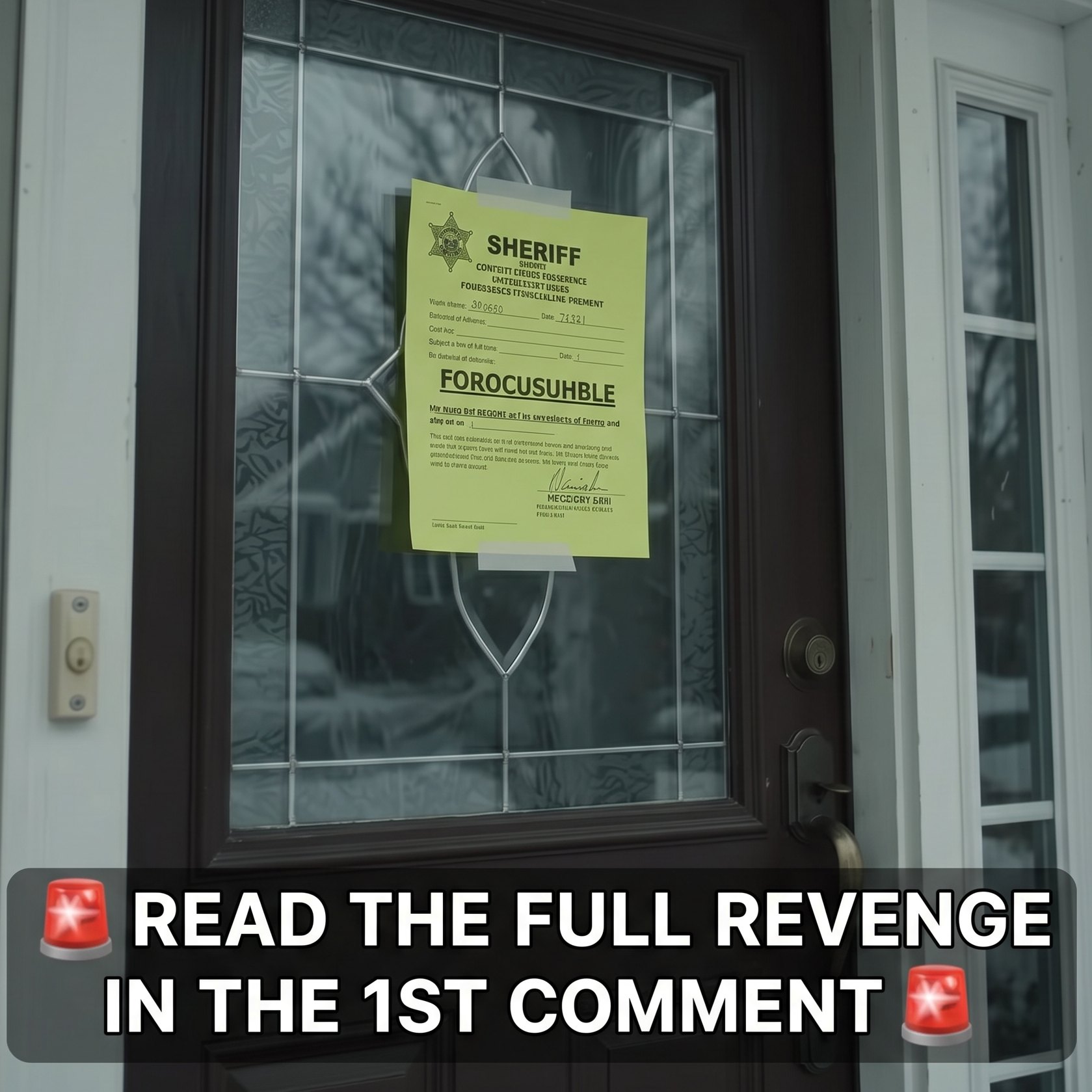
👇 FULL STORY BELOW
Chapter 1 – The Sound of the Line Going Dead
The phone rang on the formica table between my coffee mug and Micah’s half-eaten cinnamon roll. The screen lit up with the contact photo I hadn’t updated in seven years: my mother standing on her back deck in summer, holding a glass of iced tea, looking past the lens as if whatever lay beyond the fence was infinitely more deserving of her attention than whoever was holding the camera.
Micah stopped chewing. He had a smudge of white icing at the corner of his mouth, and a dried, rust-colored smear of beef juice along the side of his neck that my hasty paper-towel scrub had missed. His eyes darted from my face to the glowing phone, his shoulders creeping toward his ears in that instinctive, turtle-shell hunch I had seen him do a hundred times without ever fully understanding the cost of it.
"Is that Grandma?" he asked. His voice was small, pitched down so the barista wiping the espresso machine ten feet away wouldn’t hear.
"Yes," I said.
"Is she mad that we left before dessert?"
A sour, burning knot tightened at the base of my throat. My nine-year-old child had just sat through a bowl of boiling-hot roast beef and greasy gravy being overturned across his head, had walked out into the freezing Ohio December wind with his clothes clinging to his skin like wet parchment, and his first thought was whether he had broken etiquette by failing to stay for pumpkin pie.
"No, sweetie," I said, keeping my voice as level as a plumb line. "She isn't mad about dessert. Finish your roll. Take your time."
I slid my thumb across the screen and brought the phone to my ear. I didn't say hello. I wanted to hear which version of her had decided to dial: the aggrieved victim, the commanding general, or the domestic tyrant who treated every room in her house like a courtroom where she was both prosecutor and magistrate.
"Claire," she said immediately. No greeting. No pause. Her voice had that brittle, vibrating edge it got whenever an appliance didn't work on the first press of a button. "The digital thermostat in the hall is flashing an error code. Did you change the utility login when you set up that automatic draft, or did you give them your email? The blower just kicked off, and Arthur says the breaker isn't tripped. It’s dropping into the twenties tonight. You need to call the emergency number on the bill."
I sat perfectly still. Through the café window, the streetlights along High Street were haloed in fine, drifting flurries. A car turned into the strip mall lot, its headlights sweeping across Micah’s hands as he carefully picked a flake of pastry off his paper plate.
"Did you hear me?" she demanded, her breath hissing into the receiver. "Ross is trying to reset the furnace from the basement, but he can't find the account number to check if there's an outage on the grid. Bring your tablet back over here. And while you're at it, you left the side door unlatched when you threw your little tantrum. The draft came right down the hall and chilled the whole dining room."
Twenty-two minutes. That was how long it had been since I walked out of her kitchen. In those twenty-two minutes, I had canceled the $1,400 recurring mortgage transfer that kept her house out of default, severed my bank account from Ross’s $480 auto loan, revoked the third-party billing authorization for Columbia Gas and American Electric Power, and submitted a formal request to freeze the home equity line of credit we had used to install her quartz countertops.
She didn't know any of that yet. The banking systems were vast and slow, churning through their batch files in the dark hours of the evening. What she was experiencing right now was likely nothing more than a momentary flicker on an old Honeywell thermostat that had needed a new set of AA batteries since Thanksgiving. But in her mind, the furnace’s silence was my responsibility, just as the open door was my fault, just as the roast beef dripping from my son’s ears was an inconvenience she had already filed away under *Claire’s oversensitivity.*
"How is Micah?" I asked.
The silence on the other end lasted two full seconds. It wasn't the silence of someone caught off guard by remorse; it was the irritated pause of an executive whose subordinate had brought up an irrelevant spreadsheet during a budget meeting.
"Micah is fine," she said sharply. "He's nine years old. Boys get dirty. He made a smart-aleck remark while I was carrying a heavy dish, and my hand slipped. You made a scene out of an accident, Claire, which is typical for you. You always have to make an entrance, and you always have to make an exit. Now, what is the password for the electric portal? Arthur is sitting in his coat."
"Your hand didn't slip, Mom."
"Excuse me?"
"You stood over him, you turned the bowl completely upside down, and you tipped it directly onto the crown of his head," I said. My voice did not shake. That was the strangest part. For five years, every time I confronted my mother, my ribs had felt like they were collapsing inward, my lungs starving for air while my heart thumped against my sternum like a trapped sparrow. Tonight, there was only a wide, flat coldness. "You held it there until the juice ran down his neck. Then you told us to get out."
"I did not tip it, I lost my balance because Ross moved his chair, and if your son had been sitting up straight instead of slouching over that silly toy train like a six-year-old, it would have landed on the runner!" Her voice climbed an octave, rattling the cheap speaker in my phone. "I will not be cross-examined in my own house, Claire. Not after everything your father and I have done for you. You are thirty-one years old, you have a good job because we sacrificed to keep you in school, and the very least you can do when your family has an emergency on Christmas Eve Eve is look up an account number!"
"Call the company yourself, Mom."
"I don't have the password! You set up the online portal!"
"Then hit 'forgot password.' It's under Dad's name. It has his Social Security number on file."
"Claire Elizabeth, you do not talk to me in that tone! You drive back here right now and fix this heating issue, or so help me—"
"The heat isn't off," I said, watching Micah carefully arrange three crumbs into a straight row beside his fork. "The blower probably has a dirty filter. But if it does go off, you have Dad’s phone, and you have Ross. Ross lives there rent-free. He can call a technician."
"Ross is resting his back! He had a double shift at the warehouse last Thursday!"
"Ross hasn't worked at the warehouse since October, Mom. The manager called me three weeks ago asking if I knew where to send his final W-2 because Ross gave them my old address."
A sharp intake of breath. For a second, I thought I had broken through the wall—that the revelation of her favorite child’s latest lie would crack the veneer of her righteousness. But with Evelyn Vance, reality was merely an obstacle to be routed around.
"That warehouse was toxic," she snapped, her tone instantly hardening into defensive iron. "They were working him like a dog for twelve dollars an hour. He has chronic sciatica, which you would know if you ever asked about anyone other than yourself and your train hobbyist. Now stop playing games. Are you coming over here or not?"
"No," I said. "I'm not."
"If you don't come over here and sort out this heat, do not bother coming back for Christmas dinner tomorrow night. Don't bother bringing Micah’s gifts, either. We will give them to the church drive."
"Keep them," I said.
"Claire—"
"Goodbye, Mom."
I tapped the red circle on the screen. The call disconnected with a dry, mechanical chirp.
The café was warm. The scent of roasted beans and burnt sugar hung heavy in the air, sweet and mundane. Micah looked up at me, his eyes huge behind his plastic-rimmed glasses.
"Are we not going to Grandma’s tomorrow?" he asked.
I laid the phone face down on the laminate table. "No, buddy. We’re not."
He didn't cry. He didn't ask why. He simply picked up his fork, pressed the flat tines down against a piece of cinnamon crust, and whispered, "Can we make waffles at our house instead?"
"We can make waffles," I told him, reaching across the table to smooth down the cowlick at the crown of his head, feeling the stiff, sticky grease still clinging to the roots of his fine brown hair. "We can make as many waffles as you want. With strawberries. And the real maple syrup from the glass bottle."
A tiny, fragile smile flickered across his mouth, the first one I had seen since we walked through my mother’s front door at four o'clock that afternoon. "The kind that costs eight dollars?"
"The eight-dollar kind," I said. "Every single drop."
***
We lived four miles away, in a two-bedroom brick duplex on a quiet side street lined with silver maples. It wasn't the kind of home my mother approved of. When I signed the lease three years ago after finally walking away from the legal wreckage of my divorce, she had stood in the living room with her arms crossed, eyeing the baseboard heaters and the 1980s laminate counters with visible disgust.
*“It smells like other people’s cooking, Claire,”* she had said, wrinkling her small, sharp nose. *“A girl with a corporate title shouldn't be renting half a house from an old Greek couple. You should buy. You should look at those townhomes off Sawmill. Ross says those will appreciate twenty percent by next spring.”*
Ross, of course, had never owned so much as a lawnmower, let alone real estate. But in my mother’s house, Ross’s theoretical knowledge of the universe was treated as gospel, while my real-world management of sixty-five freight corridors for an interstate logistics firm was dismissed as "pushing papers behind a desk."
When we got inside, the first thing I did was lead Micah straight to the bathroom.
"Strip down to your underwear," I told him, turning the brass handles of the clawfoot tub until a thick, steaming torrent roared against the porcelain. "The sweater goes straight into the sink."
I took the green sweater—the one he had picked out from the Target clearance rack because he said it looked like the evergreen trees along the Northern Pacific rail line—and dropped it into cold water. A milky, brownish film immediately bloomed across the surface, smelling of sage, cheap beef bouillon, and rendered fat. I reached for the dish soap and began kneading the wool between my knuckles, pressing the heels of my hands together until the suds turned gray.
In the tub, Micah sank down until the water reached his chin. He blew a tiny raft of bubbles across the surface, watching them pop against the porcelain edge.
"Mom?"
"Yeah, sweetie?"
"Grandma said I talked back."
I stopped scrubbing. My hands were deep in the warm, greasy suds, my knuckles red from the friction. I looked over my shoulder at him. The steam had pinked his cheeks, but the shadow under his eyes was dark and bruised-looking.
"Did you talk back?" I asked gently.
"Ross said trains were stupid. He said only weird kids who don't have friends memorize engine numbers. I just told him that engines are historical. I said the Big Boy 4014 could pull three thousand tons over Sherman Hill, and that’s not stupid, that’s just engineering." He swallowed, his throat bobbing above the waterline. "Was that talking back?"
I turned back to the sink, shut off the tap with an elbow, and wrung out the green wool with so much force my wrist tendons creaked.
"No, Micah," I said, my voice vibrating with a fury so pure and concentrated it felt like cold steel in my ribs. "That was not talking back. That was you telling the truth about something you love. Ross was being mean because he is small, and he is lazy, and he doesn't know how to build anything."
"Grandma got mad because of the Big Boy?"
"Grandma got mad because she is Grandma," I said, pulling the drain plug on the sink and watching the dirty water swirl down the brass pipe. "And because she thinks she is allowed to hurt people if they don't sit there and let her family pretend they’re royalty. But she isn't allowed to hurt you. Not ever again."
I washed his hair three times with apple-scented shampoo, scrubbing the scalp with the pads of my fingers until the grease smell was entirely gone, replaced by the clean, sharp scent of fruit. When he was clean, I wrapped him in the heavy navy-blue bath sheet I had warmed on the radiator, carried him into his bedroom, and tucked him into bed with his flannel sheets and his three favorite die-cast locomotives lined up on the nightstand.
He was asleep before I could finish the first page of the library book about the transcontinental railroad. His breathing smoothed out into that soft, rhythmic whistle that had been my only steady comfort through nine years of single motherhood, nine years of shift-work promotions, nine years of late-night grocery runs and budget reconciliations.
I went into the kitchen, turned on the small desk lamp in the corner, and pulled out my work laptop.
It was 9:42 PM.
My phone, lying face down on the butcher block counter, began to vibrate again. It didn't stop. It buzzed three times, paused for the voicemail system to kick in, and then immediately began to buzz again.
I didn't answer. I picked up the landline phone—the cheap, corded receiver I kept plugged into the wall for emergencies—and dialed Dawn’s personal cell.
Dawn Miller had been my best friend since our freshman year at Ohio State, when we both worked forty hours a week at the campus credit union while carrying eighteen credit hours of logistics and finance classes. Today, she was the regional vice president of risk management for a mid-tier commercial bank in Worthington. She was also the only person on earth who had ever seen me cry about my father’s tax liens.
The phone rang twice before she picked up. The background noise was full of clinking glasses, children shouting, and the muffled brass chorus of a Nat King Cole Christmas record.
"Claire?" she said, her voice dropping into that instant, sharp alertness she reserved for liquidity crises and late-night calls from friends in trouble. "Where are you? Aren't you supposed to be at the Vance ancestral estate suffering through your mother’s overcooked roast?"
"I left," I said. "About an hour ago."
"Good for you. Did Ross make another comment about your child support?"
"Evelyn dumped the entire serving dish of pot roast over Micah’s head."
The line went completely dead. The Nat King Cole record seemed to fade into nothingness as Dawn moved away from her family gathering, the heavy thud of a closing door cutting off the holiday chatter.
"She did what?" Dawn’s voice wasn't loud. It had that flat, terrifying quietness of an auditor who has just found an unauthorized five-figure withdrawal in an executive’s personal account.
"She tipped it over him. Gravy, meat, carrots. Right onto his hair. Because he defended his model trains to Ross."
"Is Micah burned?"
"No. It was lukewarm. Just greasy and humiliating."
"Where is he now?"
"Asleep in his bed. He thinks he was punished for slouching."
Dawn exhaled slowly. Through the receiver, I could hear her pacing across hardwood floors—the familiar, rhythmic cadence of a woman who thought best while moving.
"And what did you do, Claire?"
"I took him to the café on High Street," I said, looking down at my open laptop screen, where the clean, blue interface of my primary checking account was already loading. "And while he was eating a pastry, I canceled the January mortgage transfer. I stopped Ross’s auto-draft. I removed my name from the utility authorizations. And I sent an emergency hold request on the HELOC through the member portal."
A short, sharp bark of laughter came through the line, followed by a low whistle. "Jesus Christ. The nuclear option. You really pulled the pins."
"I pulled them," I said. "Dawn, I need to know what happens on Tuesday when the clearinghouse opens."
"Alright," Dawn said, her professional tone clicking into place like the deadbolt on a vault door. "Sit down. Grab a pen. We went over this in September, but now that you’ve actually hit the switches, you need to understand the battlefield."
I pulled a yellow legal pad toward me and uncapped a blue ballpoint. "I'm listening."
"First: the voluntary payments," Dawn said. "The $1,400 for the mortgage, Ross's $480 car note, the gas, the electric. Those were personal drafts originating from *your* depository account, correct?"
"Correct. All through Huntington."
"Good. You are not a signatory on Arthur’s primary mortgage with Fifth Third, right?"
"No. Dad took that out in 2011 before his business went under. My name isn't on the note, and it isn't on the deed."
"Then you have zero legal exposure there," Dawn said cleanly. "None. The bank doesn't care that you’ve been paying it for four years. As far as Fifth Third is concerned, you were an anonymous third-party benefactor. When the January payment fails to clear on the second, Arthur will get a standard grace-period notification. He has until January sixteenth before they hit him with a late fee. He has until February first before it dings his credit bureau. But it’s *his* credit bureau, Claire. Not yours. He will get the phone call, not you."
"And Ross's car?"
"Who is the titled owner?"
"Ross. But the loan is through Ally Financial."
"Did you co-sign?"
"No," I said, a wave of profound relief washing through my collarbones. "He begged me to, but my credit score was still recovering from the divorce back then, so Ally wouldn't take me as a co-signer anyway. I just agreed to set up the monthly draft from my secondary checking account to keep them from repossessing it after his first three missed payments in 2022."
"Then Ross is about to experience the free market," Dawn said coldly. "Ally doesn't screw around with delinquent paper. They give thirty days, maybe forty-five if you talk to a hardship counselor, and then the tow truck shows up with a repossession order. If you stopped the draft tonight, Ross's December payment—which I assume was due around now—is dead in the water. He'll get a text message by Monday morning."
"What about the HELOC?" That was the one that made my stomach pitch. "That’s the one I co-signed."
Dawn went quiet for a moment. I could hear the rustle of paper—she kept a home office with binders from every institutional lender in central Ohio.
"That’s the sticky one," Dawn admitted. "The home equity line is sixty thousand dollars, right?"
"Fifty-two thousand drawn. They used thirty-five for the kitchen remodel—the cabinets, the quartz counters, the commercial range—and then Mom pulled another seventeen thousand last spring. She told me it was for structural repairs on the foundation, but Dad bought that used bass boat two weeks later."
"Right. The 'drainage improvement' that had a 150-horsepower Mercury outboard," Dawn muttered. "Here’s how the HELOC works, Claire. Because you are a co-signer, you are jointly and severally liable. That means the bank doesn't care who bought the quartz or who bought the boat. If Arthur defaults, they can come after you for the full fifty-two thousand. They can sue you, they can garnish your wages, and they can trash your FICO score down into the four hundreds."
"I sent the hold request through the portal," I said. "Will that stop them from pulling the rest of the limit?"
"The remaining eight thousand? Yes. If a co-signer flags potential fraud, unauthorized draws, or requests an immediate freeze pending documentation, the compliance department is legally required to lock the draw privileges until both parties sign a reaffirmation agreement. That protects the ceiling. But it doesn't pay the monthly interest on the fifty-two thousand that’s already out the door."
"How much is the monthly interest?"
"At current prime plus two? Probably around four hundred and twenty dollars a month, interest-only," Dawn calculated without missing a beat. "If Arthur doesn't pay it, the lender will start calling you by mid-January."
"Can I force a sale?"
Dawn paused. "Of the house? Not easily. You aren't on the deed. You’re on the note, which is the worst possible legal position: all of the liability, none of the equity. But here’s what you *do* have, Claire: you have the bank statements showing that for forty-eight months, you were the sole party servicing the debt on Arthur’s mortgage and the primary line. You have a paper trail showing you transferred over sixty-seven thousand dollars directly into their household ecosystem since Dad's business went under."
"Does that give me leverage?"
"It gives you a massive, glowing neon sign for a forensic accountant if this goes to civil litigation," Dawn said. "And it gives you the moral and financial high ground if we need to petition the lender for an involuntary restructuring. But listen to me: Evelyn isn't going to let this get to court. Evelyn lives entirely on social credit in that subdivision. She’s on the neighborhood garden committee. She runs the holiday cookie exchange. If Fifth Third puts a yellow default notice on her front door, her head will explode."
"She thinks I'm going to fold," I whispered. "She thinks by tomorrow morning, I'll be so scared of being left out of Christmas that I'll log back into the portal and pay the heat bill."
"Are you going to?"
I looked at the yellow legal pad. I looked at the numbers I had scribbled down:
*Mortgage:* $1,400
*Ross’s Car:* $480
*Electric/Gas:* $310
*HELOC Interest (estimated):* $420
*Total monthly extraction:* $2,610.
Two thousand, six hundred and ten dollars. Every single month. For four years.
That was thirty-one thousand dollars a year. Over four years, that was more than one hundred and twenty thousand dollars.
That was Micah’s college fund. That was the down payment on the small, four-bedroom house with the wrap-around porch and the two-stall garage near the park in Worthington that I had looked at two summers ago and told myself I couldn't afford. That was the difference between my son wearing thrift-store sweaters and him having a mother who didn't spend every Sunday night staring at a spreadsheet with an ice pack pressed against her forehead to stop the tension migraines.
"No," I said. "I'm not folding."
"Then brace yourself," Dawn said softly. "Because when a family like yours realizes the bank account has a brain and a backbone, they don't apologize. They escalate."
***
The first escalation came at 11:15 PM.
I was sitting on the living room sofa, wrapped in an old fleece blanket, drinking peppermint tea and watching the snow accumulate on the railing of our small back porch. The house was dead quiet except for the hum of the refrigerator and the faint, regular clicks of the baseboard heaters.
My phone rang again. It wasn't my mother this time.
The screen read: **ROSS.**
I stared at it for four rings before I pressed the green button and switched on the speakerphone.
"Claire?" Ross didn't sound angry; he sounded aggrieved, with that oily, practiced whine he had used since he was twelve years old to get out of mowing the lawn. "Claire, what the hell is going on with the Huntington card? I’m at the Speedway on Bethel trying to get gas and a case of beer, and the pump declined the card twice."
"The card is canceled, Ross."
"What do you mean, canceled? That’s the account for my car! I have to put premium in the Audi or the check-engine light comes back on! You know that!"
The Audi was a 2017 A4 with peeling window tint and an aftermarket exhaust that Ross had bought off a used-car lot on Cleveland Avenue with money he didn't have. He had convinced our father to co-sign the initial purchase, and when Arthur couldn't make the notes, they had collectively brought the bill to me during Sunday dinner like a stray dog they expected me to feed.
"The account isn't canceled," I said evenly. "I just removed the automated draft. And I withdrew the funds I put in there on Tuesday."
A long silence followed. I could hear the faint *ding-dong* of the gas station door opening, the hiss of the air brakes on a semi pulling onto the highway, and Ross’s heavy, cigarette-roughened breathing.
"You took the money back?"
"Yes."
"Claire, the car note is due tomorrow! It’s the twenty-fourth! If the draft doesn't hit by midnight, Ally adds a forty-five-dollar late fee!"
"Then you should pay it tonight," I said. "Before midnight."
"With what?" he yelled, his voice cracking into that high, petulant register he used whenever our parents weren't around to back him up. "I don't have four hundred and eighty dollars in checking! You know I'm between gigs right now! I'm doing that remote marketing consultation thing with Kyle, but the payout doesn't happen until mid-January!"
"The remote marketing thing with Kyle is a crypto Discord server, Ross," I said. "You've been telling me that payout is coming since July. You haven't had a job since the warehouse fired you for failing three consecutive drug screens."
"Mom told you that?"
"No. The warehouse HR manager told me when she tried to locate you."
"She’s a liar! That place was full of snakes!" Ross was shouting now, his voice echoing off the concrete canopy of the gas station. "Listen to me, you selfish bitch! You log into your app right now and put five hundred dollars back into that account! Mom is back at the house crying her eyes out because the dining room is sixty-two degrees and Dad is having chest pains from the stress you caused!"
My fingers gripped the phone so hard the plastic case creaked. "If Dad is having chest pains, call 911."
"You think this is funny? You think you can just walk out of Christmas, ruin dinner, embarrass Mom in front of everyone, and then leave us out in the cold? Literally in the cold? Dad’s blood pressure is through the roof!"
"Ross," I said, my voice dropping so low he had to stop yelling to hear me. "Micah is nine years old."
"What does Micah have to do with my car?"
"Evelyn dumped boiling roast beef on his head. Gravy went down his shirt. He was crying in the car on the way home, wondering what he did wrong."
"He was being a smart-ass!" Ross spat. "He's always acting like he’s better than everyone else because he reads those stupid books! He needed to be taken down a peg! Mom didn't mean to spill the damn gravy, she was just trying to get his attention, and you went completely psycho like you always do!"
I looked at the model train box sitting on the hall table—the 1940s steam engine Micah had spent three weeks painting with tiny, number-zero detail brushes, using his own allowance money to buy the matte black enamel and the tiny brass decals for the cab.
"The car payment is your problem, Ross," I said. "The gas is your problem. The heat is your problem. And if you call this number again tonight, I will block your phone, I will block Dad’s phone, and I will call the Columbus Police Department to report harassment."
"You wouldn't dare," he sneered. "You need us. You don't have anyone else. Mark left you with a kid and a broken lease, and nobody else is going to put up with your controlling, uptight bullshit. You think you’re so high and mighty with your corporate title? You’re just a lonely, bitter supply-chain clerk who’s going to spend Christmas morning in a rented duplex with a weird kid who plays with toys!"
I didn't answer. I didn't raise my voice. I didn't give him the satisfaction of a sharp retort or a defensive tear.
I simply pressed the red button.
Then I opened the settings on my phone, navigated to the contact card labeled **ROSS**, and selected **BLOCK THIS CALLER.**
Next, I went to **EVELYN VANCE** and selected **BLOCK THIS CALLER.**
I hesitated over my father’s name: **ARTHUR VANCE.**
My father hadn't spoken more than three sentences to me at dinner. He had sat there, his thick, work-roughened fingers gripping his fork, his eyes fixed on the linen tablecloth while his wife humiliated his only grandson. When I stood up to leave, he had simply cut another piece of potato, dipped it into the smear of brown sauce remaining on his plate, and chewed.
He wasn't cruel like my mother. He wasn't loud and venomous like Ross. He was worse: he was the man who held the flashlight while other people did the digging. He was the great, silent enabler who traded his daughter’s savings and his grandson’s dignity for fifteen minutes of peace from his wife’s tongue.
I didn't block him. I wanted there to be one open door—not for them to apologize, because I knew with absolute certainty that Evelyn Vance would rather swallow broken glass than admit she had made an error, but because when the roof finally caved in, I wanted to hear the sound of the timber snapping under Arthur’s feet.
I closed my laptop, walked into Micah’s room, and stood in the doorway for a long time, watching the rise and fall of the navy-blue blanket.
Outside, the snow was falling faster now, settling thick and heavy over the rooftops of Columbus, burying the driveways, the frozen lawns, and the quiet, empty streets.
Tomorrow was Christmas Eve. For thirty-one years, Christmas had been a performance staged for Evelyn’s benefit—a high-stakes theatrical production where the costumes had to be clean, the children had to be silent, and the checks had to be signed on time.
May you like
I had been gone for fourteen hours when I walked into my own condo and w…
Escaping Her Abusive Husband, Curvy Woman Hid Under The Desk Of A Mafia…
Five hundred people were watching when my future mother-in-law publicly…
Tomorrow, for the first time in my life, the stage was going to be completely dark.
***