I Came Back to Town in My Luxury SUV and Saw My Ex-Wife Searching Through Trash for Bottles Beneath a Bridge.
I Rolled Down the Window, Tossed $500 Into the Mud, and Mocked Her, “Did the Millionaire Finally Abandon You?” She Didn’t Pick Up the Money.
She Simply Looked at Me and Kept Walking.
Curious, I Followed Her.
What I Found Inside Her Tiny Room Left Me Unable to Breathe.
“Pick it up.
For someone living off garbage, a fifty-dollar bill still goes a long way, right?”
I shouted it out the window of my pristine pickup truck with a cold, smug malice that makes me physically sick to recall today.
It was raining heavily over Chicago that Tuesday afternoon.
I was stuck in bumper-to-board traffic near an overpass, deeply irritated because a corporate board meeting had dragged on longer than expected.
I was thirty-nine years old, owned a lucrative chain of high-end furniture showrooms, and possessed the arrogant certainty that money made me immune to being fooled.
Then I saw her.
A thin, fragile woman draped in a torn blue raincoat was rummaging through heavy bags near a row of commercial dumpsters.
She was carefully sorting plastic bottles and wet cardboard into a torn sack.
A sudden gust of wind blew her hood back, exposing her face.
It was Lucy, my ex-wife.
The woman I had accused three years earlier of sleeping with a key supplier and embezzling over two hundred thousand dollars from my business.
The same woman I had thrown out of my house in the middle of a thunderstorm without giving her a single minute to defend herself.
I reached into my leather wallet, crumpled a fifty-dollar bill into a tight ball, and tossed it out the window.
It landed squarely in a muddy puddle right in front of her worn boots.
“What happened to your multi-millionaire, Lucy?” I sneered, leaning out the door.
“Did he kick you to the curb too?”
Lucy looked down at the floating bill, then slowly raised her eyes to meet mine.
“Keep your money, Alexander,” she said, her voice terrifyingly calm.
“You might need it to buy yourself a tiny piece of peace when you finally realize what kind of monster you’ve become.”
She nudged the money deeper into the mud with her boot and kept walking down the alley.
I don’t know why I put the truck in park and got out to follow her.
Maybe it was because I saw her clutching a small bag from a pharmacy and a cheap plastic container of hot soup.
Or maybe it was because I noticed her heavy limp, and for the first time in three years, my version of the truth stopped making sense.
I trailed her through a dilapidated industrial neighborhood along the canal, where the roads were mud and the homes were rotting wooden shacks.
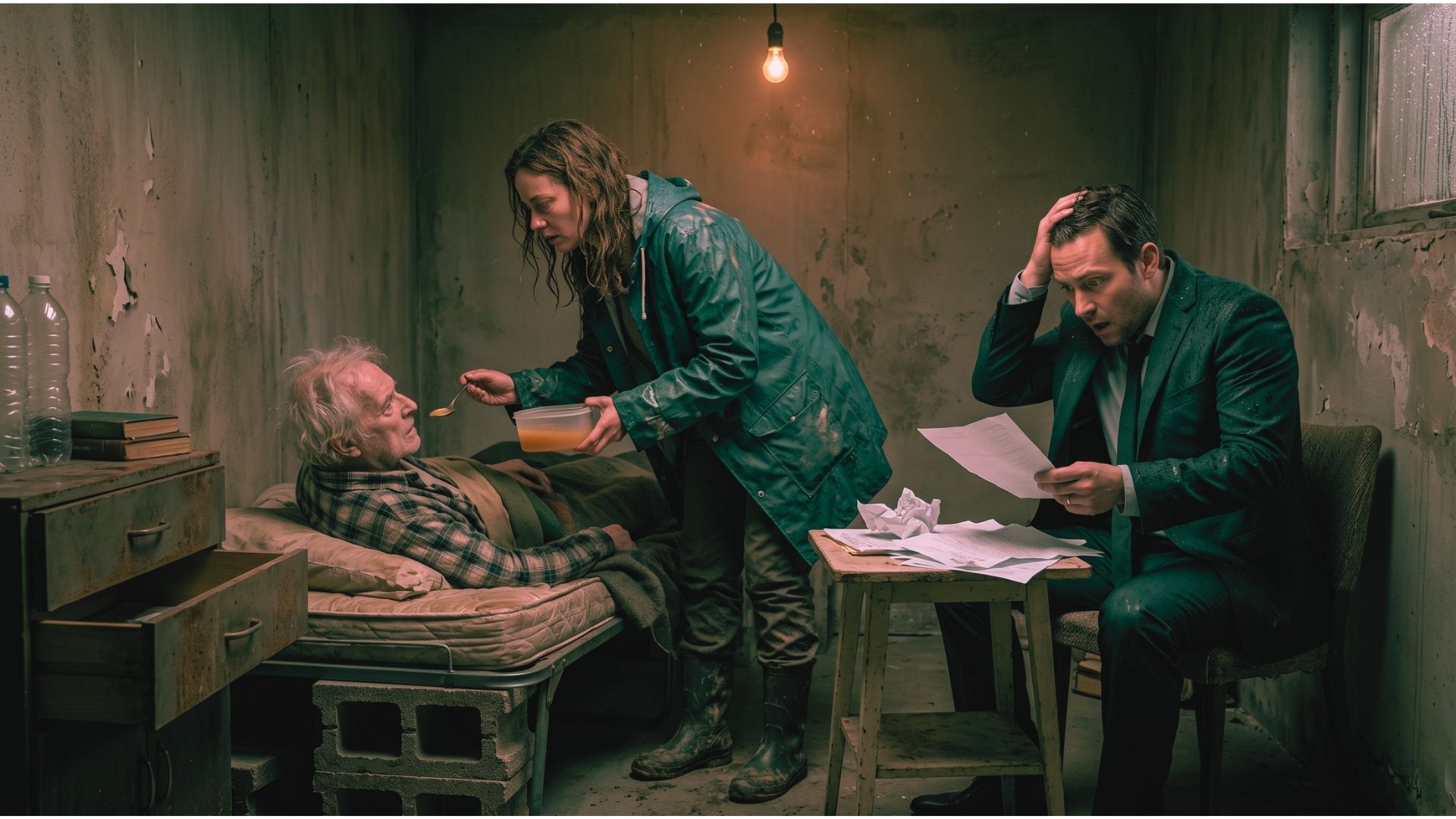
Lucy stepped into a cramped, windowless room.
“I’m home, Dad,” she called out softly.
“I brought you some warm broth.”
I froze in the doorway.
We had never had children.
Then my eyes adjusted to the dim light, falling on the elderly man lying on a narrow cot in the corner.
Half of his body was paralyzed, his face hollowed by a stroke, his hair completely white.
It was my father, Arthur.
For the last six months, I had been wiring thirty-five hundred dollars every month to my younger sister, Maya, for my father’s care at a luxury senior living facility in the suburbs.
Every week, Maya sent me photos and videos of my dad in manicured gardens, private physical therapy sessions, and pristine dining rooms.
Yet here he was, lying on a saggy mattress propped up on cinder blocks, while my ex-wife wiped his chin and fed him soup bought with money earned from collecting aluminum cans.
I stepped into the room, my mind spinning.
“Dad?!”
He burst into silent tears when he recognized me, trying desperately to form words, but producing only guttural rasps.
I spun around and grabbed Lucy’s arm, blinded once again by panic.
“What did you do to him?!
Why is he living in a hovel?!”
Lucy yanked her arm free, opened a rusty drawer, and threw a stack of medical papers onto the small wooden table.
“You still point fingers before asking a single question,” she said coldly.
I snatched up the top page.
It was an official hospital discharge form.
It stated that a legal family representative had signed my father out of an emergency care unit against medical advice, refusing to authorize necessary rehabilitation.
At the bottom rested the signature: Maya Vance.
My sister.
“This is fake,” I stammered, stepping back.
“Maya sends me videos of Dad from the sunrise resort every single week!”
Lucy let out a dry, bitter laugh.
“Then go ask your sister why your father was abandoned at two in the morning in the waiting room of a free public clinic without a dime to his name.
And ask her why the only emergency contact number on his chart belonged to the ex-daughter-in-law you threw out like trash.”
My father reached out with his one working hand, gripping my wrist, shaking his head frantically as tears rolled into his white beard.
Lucy stepped directly into my space, her eyes burning.
“And if you think this is a nightmare, Alexander…
you don’t even know the real reason your father had a stroke in the first place.”
Standing in that freezing, damp room, I realized that everything I had built my life on for the past three years was an absolute lie — and the truth was about to tear my world apart.
What did Maya do with that money — and what really caused Arthur’s stroke?