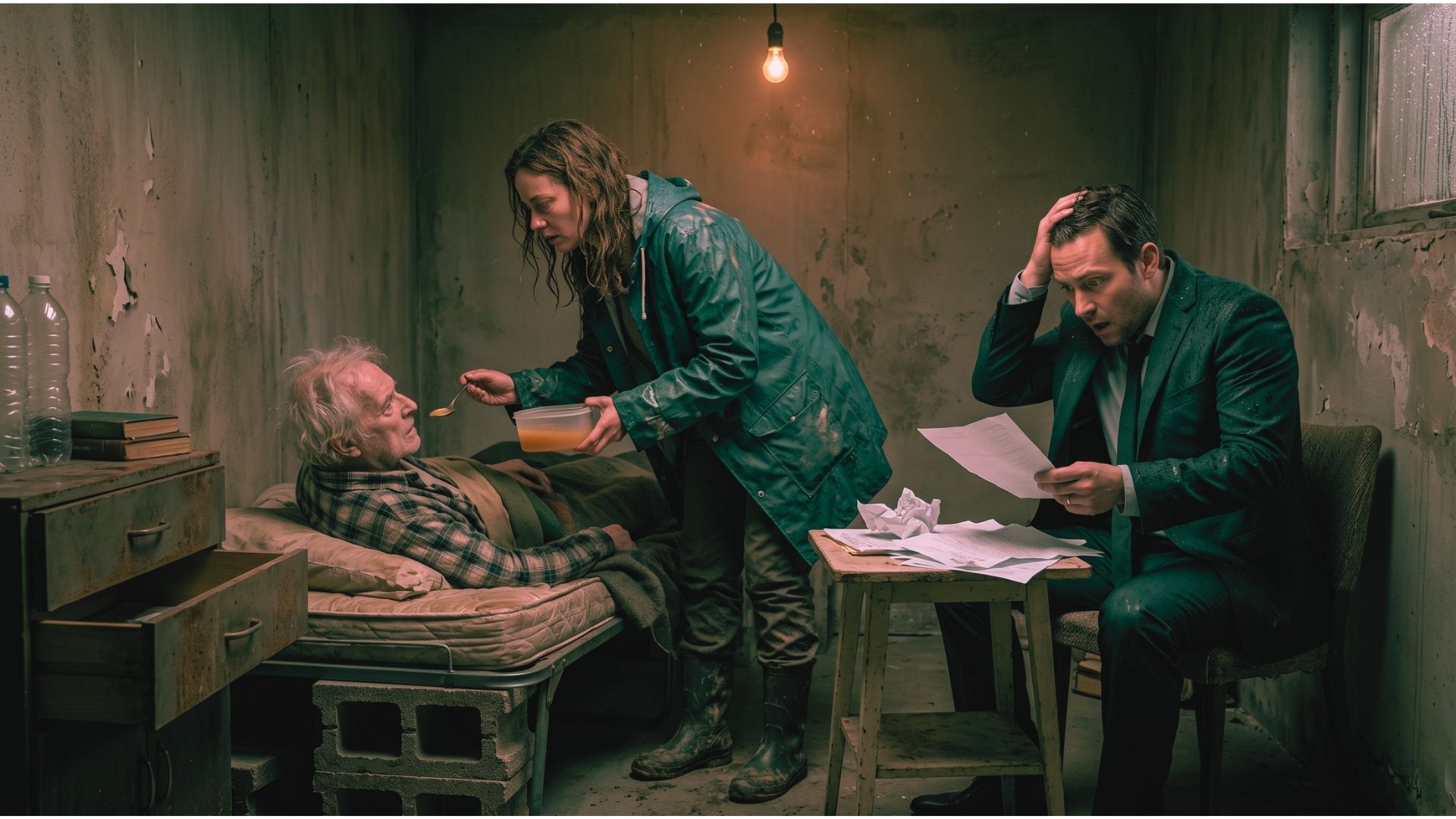
The room felt different when I walked in that evening.
Arthur was propped up slightly against his pillow, more alert than I had seen him.
Lucy was at the small table, and across from her sat an older man I didn’t recognize — heavyset, with a grey beard and a canvas jacket, a paper cup of coffee in both hands.
“Alexander,” Lucy said.
“This is Raymond Cole.”
He had driven from Portland.
I hadn’t asked him to.
He had called Lucy that afternoon, after Patricia’s team had contacted him, and he had simply gotten in his car.
He stood up and extended his hand.
“Mr.
Vance.
I owe you a conversation I should have insisted on three years ago.”
We shook hands.
I sat down.
“You went to Lucy,” I said.
“I did.
And then Lucy got fired before she could bring me to you, and I panicked.
I moved my operation to Portland and I told myself it wasn’t my problem anymore.” He looked at his coffee cup.
“I’ve had three years to think about how wrong that was.”
“You kept the documentation.”
“Every page.
I didn’t know what I was going to do with it.
But I kept it.” He reached into his jacket and set a thick envelope on the table.
“It’s all there.
The original approach, the names, the invoice numbers, the dates.
I also have emails.
Daniel was careful on the phone, but he wasn’t careful in writing.
Not in the early days, when he thought I was fully on board.”
I opened the envelope.
The first email was dated four years ago.
The subject line was *Restructuring Opportunity — Confidential.*
I read the first paragraph.
Then I set it down.
“He approached you before Lucy and I had any problems,” I said.
“Eight months before,” Raymond said.
“He was already building it.
The plan to redirect the supplier invoices, the plan to create the paper trail pointing at someone inside the business.
He just needed to decide who to point it at.” He paused.
“I think he always intended it to be Lucy.
She was the one with access.
She was the one who would be hardest to defend once the records were altered.”
Lucy was quiet across the table.
She was looking at her hands.
“Lucy,” I said.
She looked up.
“I’m sorry.” The words came out flat and insufficient and I knew it.
“I know that doesn’t — I know there isn’t a version of sorry that covers what I did.”
She didn’t say *it’s fine.* She didn’t say *I forgive you.* She held my eyes for a moment and then she said, “I know.”
That was enough.
More than I deserved.
Arthur made a sound from the cot.
We all turned.
He was looking at me with his one mobile eye, his working hand raised slightly off the blanket.
His mouth was moving.
I went to him.
I crouched down beside the cot so we were level.
“Dad.”
He tried again.
The stroke had taken most of his speech, but he had been working at this particular word for months, Lucy told me later.
He had practiced it every morning.
It came out slurred and effortful and completely clear.
*”Home,”* he said.
I took his hand in both of mine.
“Yes,” I said.
“We’re going home.”
Lucy stood up from the table.
She didn’t say anything.
She went to the small shelf above the cot and began folding the few items there — a photograph, a pair of reading glasses, a small wooden cross — into a cloth bag with the quiet efficiency of someone who had been ready for this moment and hadn’t known when it would come.
Raymond Cole finished his coffee.
He set the cup down and picked up his envelope.
“I’ll be in Chicago for two days,” he said.
“Whatever the investigators need from me, I’m available.”
“Thank you,” I said.
“For coming.”
He nodded.
He looked at Lucy once, a look that carried something between apology and respect, and then he left.
The room was quiet except for the rain and the sound of Lucy folding.
My phone lit up on the table.
A message from Patricia: *Warrant executed at 6:47 a.m.
tomorrow.
Daniel’s attorney has been notified.
Maya’s attorney called twenty minutes ago.
She wants to cooperate.*
I read it twice.
Then I turned the phone face-down.
There would be time for all of that.
There would be lawyers and statements and the long, grinding machinery of consequence.
There would be a conversation with Maya that I was not ready for and might never be fully ready for.
But right now, in this small damp room by the canal, my father was looking at me with wet eyes and one raised hand, and the woman who had stayed when everyone else had walked away was packing the last of his things into a cloth bag.
“Lucy,” I said.
She looked up.
“You’ve been carrying this alone for four months.
Let me carry something.”
She looked at me for a long moment.
Then she handed me the cloth bag.
I took it.