Patricia called at seven-fifteen the next morning.
“It’s done,” she said.
“Daniel was taken in for questioning at six forty-seven.
His attorney is already in the room.
The financial crimes unit has the server records, the bank statements, Raymond’s documentation, and the voicemail.” A pause.
“He’s not going to be able to talk his way out of this one.”
“And Maya?”
“She’s cooperating fully.
Her attorney negotiated an interview this morning.
She’s given them Greg Holloway’s name, the offshore routing information, and the original plan as Daniel presented it to her.” Patricia’s voice was careful.
“Alex, Maya’s cooperation doesn’t erase what she did.
But it will matter at sentencing.”
“I know,” I said.
“Do you want to speak with her?”
I looked across the room.
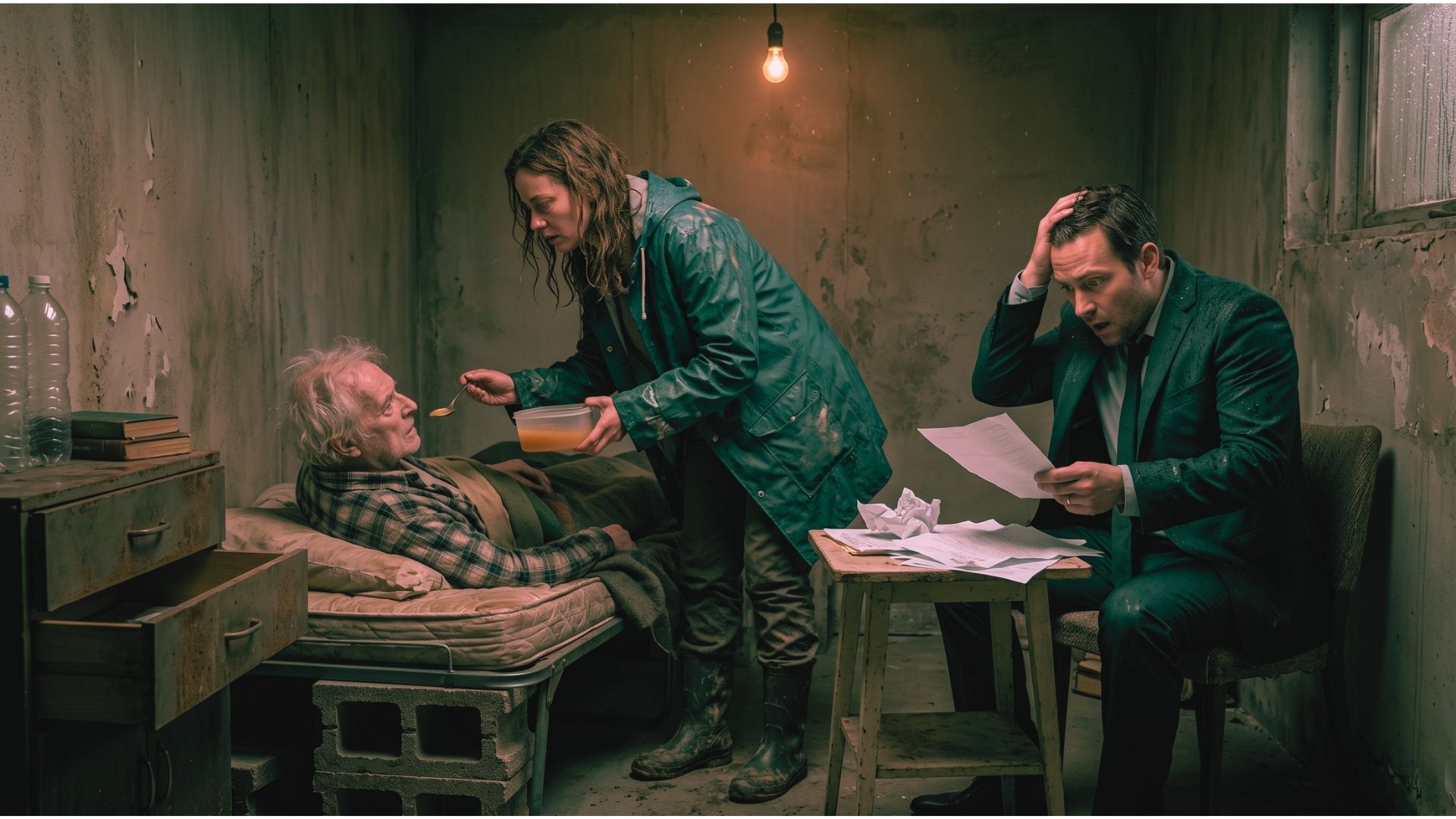
My father was in a proper hospital bed now, in a private room at Northwestern, with a neurologist and a rehabilitation team and a window that looked out over a courtyard with bare November trees.
He had been admitted the previous evening.
The intake nurse had looked at his discharge paperwork and gone very quiet before excusing herself to find the attending physician.
“Not yet,” I said.
“Tell her attorney I’ll be in contact when I’m ready.”
I ended the call and sat back in the chair beside my father’s bed.
Arthur was asleep.
His color was better already — something about a real mattress and a warm room and medication administered correctly.
The rehabilitation team had assessed him that morning and said, cautiously, that with consistent therapy there was meaningful recovery possible.
Not complete.
But meaningful.
Lucy was in the hallway.
She had stayed through the admission process the night before, answering the nurses’ questions about his medications and routines and dietary needs with a precision that made the attending physician ask how long she had been his primary caregiver.
“Four months,” she had said.
The physician had looked at her for a moment.
“You did well by him,” he said.
“Given the circumstances.”
She had nodded once and looked at the floor.
I found her now at the end of the hallway, standing at the window with a paper cup of coffee, watching the courtyard below.
“The retraction went to both industry associations yesterday afternoon,” I said.
“Patricia filed the formal correction this morning.
Your name is clean.”
She didn’t turn around immediately.
When she did, her face was composed, but her eyes were doing something complicated.
“Three years,” she said.
“I know.”
“I couldn’t get a position in this industry for three years.
I had two interviews that ended the moment they ran my background.
I ended up doing data entry for a logistics company until they downsized.
And then I was doing what you saw yesterday.” She looked at her coffee.
“I’m not telling you this to make you feel worse.
I’m telling you because I need you to understand that an apology and a retraction, as necessary as they are, don’t give me those three years back.”
“No,” I said.
“They don’t.”
“I also need you to understand that I don’t hate you.” She looked up.
“I spent a long time being angry.
I’m not going to pretend I wasn’t.
But I found your father abandoned at a clinic at two in the morning, and I made a choice, and that choice was mine.
I didn’t do it for you.
I did it for him, and for myself, because I couldn’t live with walking away from a good man who needed help.”
“I know that,” I said.
“I’ve known it since the moment I walked into that room.”
She nodded slowly.
“So.
What happens now?”
“I’m going to make sure my father has everything he needs for as long as he needs it.
That starts today.” I paused.
“I’m also going to make sure you’re compensated for the four months of care you provided.
Properly.
Whatever a professional caregiver would have charged, plus everything you lost in income during that time.”
“Alexander — “
“It’s not charity.
It’s a debt.
Let me pay it.”
She was quiet for a moment.
Then she said, “I want to go back to work.
In the industry.
What I was doing before — supplier relations, contract management.
That’s what I’m good at.”
“I know it is,” I said.
“You were the best person I had.”
She looked at me steadily.
“I’m not asking you for a job.”
“I know you’re not.” I held her gaze.
“But if you ever decide you want one, it’s there.”
She looked out the window again.
Below, a nurse was walking a patient slowly around the courtyard path, both of them bundled against the cold, moving at the careful pace of someone learning to trust their own legs again.
“He said *home* last night,” Lucy said softly.
“Your father.
That was the first full word he’s said in four months.”
“I heard it.”
“He practiced it every morning.
I didn’t know what he was practicing for.
I thought he was just trying to rebuild the muscle.” She paused.
“I think he knew you’d come back.”
I didn’t have an answer for that.
I wasn’t sure I deserved to have one.
Daniel Marsh was formally charged eleven days later.
The charges included wire fraud, financial elder @buse, and conspiracy.
His attorney filed for a continuance.
The judge denied it.
Raymond Cole testified in the preliminary hearing and his documentation was entered into evidence without objection.
Maya pleaded guilty to a reduced charge in exchange for her full cooperation.
She was sentenced to two years of supervised probation, full restitution, and two hundred hours of community service.
She called me the evening after sentencing.
I picked up.
“I’m sorry, Alexander,” she said.
“I know that’s not enough.”
“No,” I said.
“It isn’t.”
“I know.” A long silence.
“How is Dad?”
“He said his first sentence last week,” I said.
“Four words.
The therapist cried.”
Another silence.
Then, very quietly: “Will you tell him I called?”
“Yes,” I said.
“When he’s ready to hear it.”
I ended the call and sat in the quiet of my father’s room.
Arthur was asleep, his breathing slow and even, his color better than it had been in months.
On the nightstand beside him was the cloth bag Lucy had packed in that small room by the canal — the photograph, the reading glasses, the small wooden cross.
I had offered to replace them with better things.
He had shaken his head.
He wanted those things.
The ones she had kept for him.
I understood.
Three months later, Lucy accepted a position with a supplier relations firm in the city.
Not mine.
Her own choice, her own path, the way it should have been all along.
She stopped by the rehabilitation center on her first day to show my father her new badge.
He held it in his working hand for a long time, turning it over, reading her name.
Then he looked up at her and smiled with the half of his face that still could.
She sat with him for an hour.
They didn’t talk much.
They didn’t need to.
I watched from the doorway and didn’t go in.
Some moments aren’t mine to enter.
The last thing I did that evening, before I drove home, was stop at the overpass on the canal road.
I got out of the truck.
The alley below was empty.
The dumpsters were still there.
The puddle where a fifty-dollar bill had floated in the mud was just a puddle now, ordinary and unremarkable.
I stood there for a while in the cold.
Then I got back in the truck and drove away, and I did not look in the rearview mirror.
—
Some people stay loyal to us long after we’ve given them every reason to walk away.
And sometimes the greatest act of courage isn’t fighting back — it’s simply refusing to become as small as the person who hurt you.
Have you ever had someone stand by you when you least deserved it — or been that person for someone else?