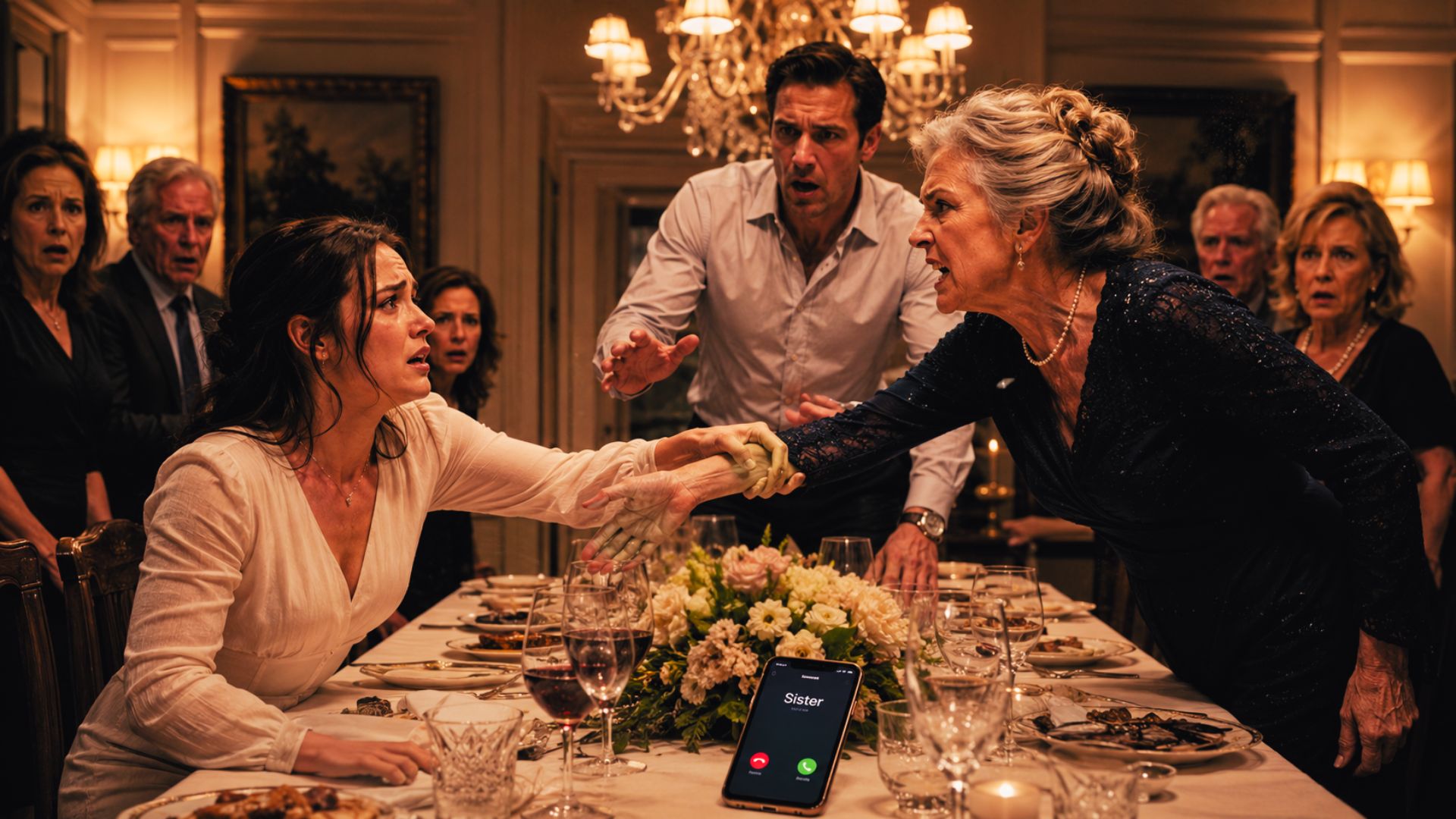
The fraud case moved faster than Ruth had expected.
Gerald Holt cooperated within the first week.
He had records going back fourteen months — every transfer, every instruction, every email.
He had kept them, Ruth told me, because he had known from the beginning that Diane would find a way to make him the primary responsible party if anything went wrong.
He had protected himself by documenting everything.
Diane was formally charged six weeks after the dinner.
Dissipation of marital assets.
Fraud.
Conspiracy to conceal.
Her attorney argued that she had been acting in good faith as trustee of a family financial instrument.
The forty-seven emails Karen had copied made that argument very difficult to sustain.
I was not in the room when she was charged.
I was in Ruth’s office, reviewing the final settlement terms.
The settlement was fair.
More than fair, given what had been concealed.
Ruth had argued well and the documentation had been thorough and Michael had kept every promise he made in that conference room.
I signed the papers on a Thursday morning.
I noticed the day only because of what Thursdays had meant for eight months, and then I let it go.
Rachel called once, three weeks after the dinner.
I let it ring.
She left a voicemail that I listened to once and then deleted.
Not out of anger.
Out of the understanding that some things cannot be repaired by a voicemail, and that she would need to find her own way through what she had done.
That was not my work to carry.
Karen and I had coffee the following month.
A small place near her office, nothing arranged, just two people who had been through something together and needed to sit with that for an hour.
She told me Diane had moved in with a cousin in another state while the legal proceedings continued.
She told me Michael had started seeing a therapist.
She told me she had finally told her husband everything — the full history of how their mother operated — and that it had been the hardest and most necessary conversation of her marriage.
“How is he taking it?” I asked.
“He’s angry,” she said.
“But he’s still there.
That counts for something.”
“It counts for a lot,” I said.
I moved into a smaller apartment in April.
Two bedrooms, more than I needed, but the second room had good light and I had started painting again — something I had set down years ago and not picked back up.
I didn’t know why I had stopped.
I knew why I had started again.
The first painting I finished was nothing dramatic.
A window.
Morning light coming through it at an angle, falling across a wooden floor.
No people in it.
Just the light and the floor and the quiet.
I hung it in the hallway where I would see it every morning when I walked to the kitchen.
Ruth came to see the apartment in May.
She stood in the hallway and looked at the painting for a long moment.
“You made that?” she said.
“Last month.”
“It’s good.” She tilted her head.
“It feels like breathing.”
That was exactly what I had been trying to paint.
I hadn’t told her that.
We had dinner at my small table, the two of us, and we talked about everything except the case.
We talked about the podcast we still both followed.
We talked about her daughter’s school play and my mother’s upcoming birthday and a book we had both read and disagreed about in the best possible way.
When she left, I washed the two plates and set them in the drying rack and stood at the kitchen window for a moment.
The city was quiet at that hour.
A few lights on in the building across the street.
Someone walking a dog below.
The same ordinary world that had been there all along, continuing without drama, patient and unhurried.
I had been so afraid, in the weeks after the dinner, that I would feel hollowed out.
That the anger and the grief and the shock would leave nothing behind when they finally receded.
But they had left something.
A quieter version of myself.
One who had learned, the hard way, what she was actually made of.
I turned off the kitchen light and went to bed.
In the hallway, the painting caught the last of the streetlight through the window.
The light on the wooden floor.
The ordinary, particular, irreplaceable light of a morning that belonged to no one but itself.
That was enough.
It was more than enough.
—
*Sometimes the people closest to us are the ones we never truly saw clearly — until the moment everything breaks open, and the truth has nowhere left to hide.*
Have you ever had a moment when you realized someone you trusted completely was not who you believed them to be?
Share your story in the comments — you are not alone.