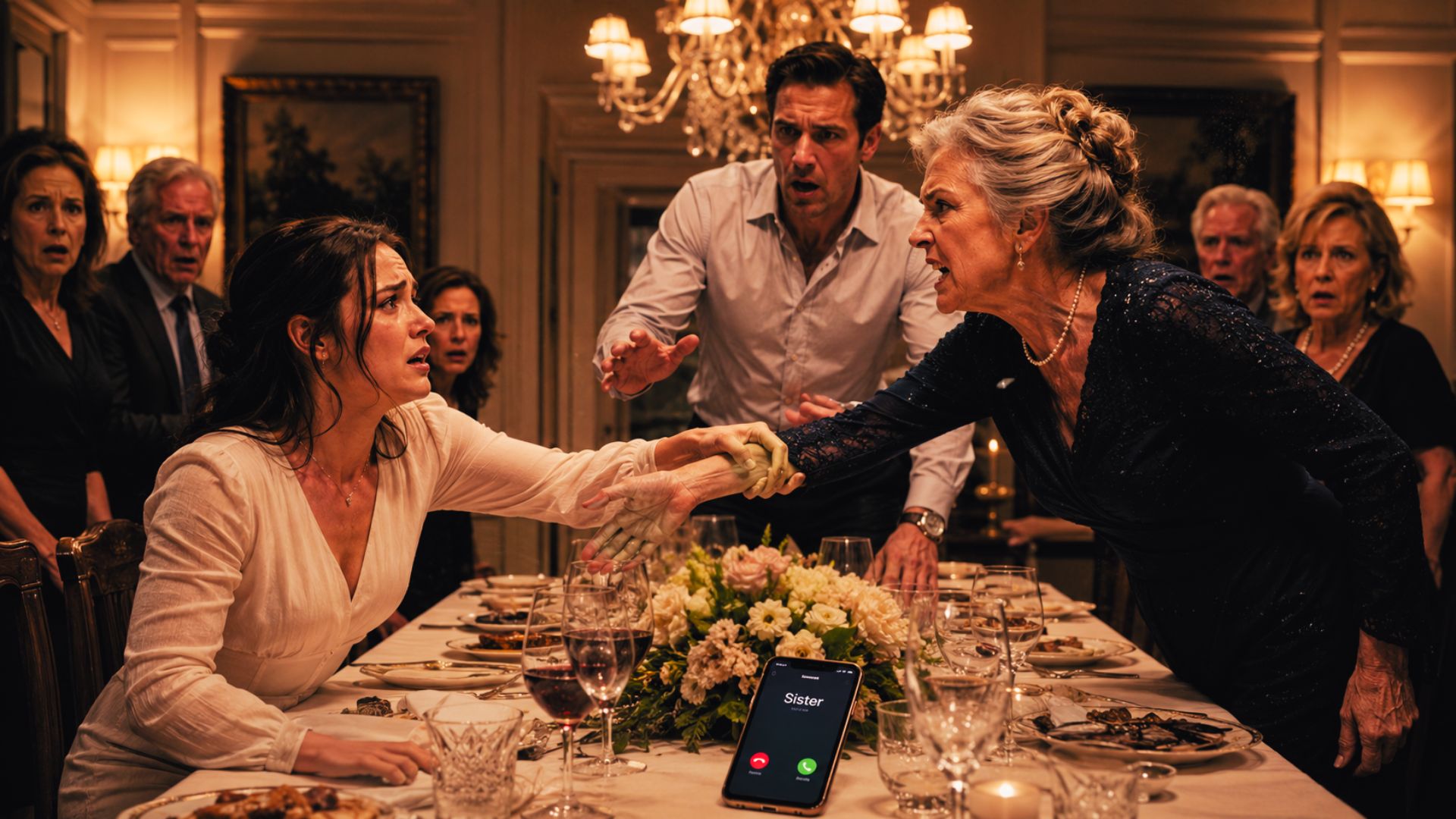
He called that afternoon.
I was at Ruth’s office, going through documents, when his name appeared on my screen.
Ruth looked at me.
“You don’t have to answer.”
“I know.” I picked it up.
“I need to talk to you,” Michael said.
His voice was flat.
Not angry.
Not pleading.
Just flat, in the way of someone who has run out of performances.
“Then talk.”
A pause.
“Not on the phone.
Can I—”
“No.
You can say it now or you can say it to my attorney.”
Another pause.
Longer.
“She told me you’d already signed the separation agreement,” he said.
“Two weeks ago.
She said you’d been to a lawyer and you’d already decided and the dinner was just — she said it was a chance for everything to come out cleanly.
So there were no surprises.”
I didn’t say anything.
“I know how that sounds,” he said.
“I know.
But she showed me a document.
She said it was your signature.”
“It wasn’t.”
“I know that now.” His voice dropped.
“I think I knew it then.
I didn’t let myself look too hard at it.”
“Because looking would have meant stopping her.”
“Yes.”
The word sat there between us on the phone line.
“Michael, I need you to answer one question honestly.
And I need you to think before you answer.”
“Okay.”
“Did you love her?
Rachel?”
A long silence.
“No,” he said.
“I don’t think I did.
I think I was — I think I was trying to give my mother a reason that wasn’t about money.
Something that made it about feelings instead of finances.” He stopped.
“That’s worse, isn’t it.
That’s actually worse.”
“Yes,” I said.
“It is.”
“I’m sorry.” The words came out broken at the edges.
“I know that doesn’t—”
“It doesn’t fix anything,” I said.
“But I heard it.”
Ruth was watching me from across the desk.
I held up one finger.
“Michael.
My attorney needs a statement from you.
About the transfers.
About Gerald Holt.
About the document your mother showed you with my supposed signature.” I paused.
“If you give that statement, it helps you.
It helps close this faster.
And it means Diane and Holt face the full weight of what they did instead of you carrying part of it.”
Silence.
“She’s my mother,” he said.
“I know.”
“She did all of this because she thought she was protecting me.”
“I know that too.” I kept my voice steady.
“And she broke the law doing it.
And she used your grief and your weakness and your need to please her to do it.
That’s not protection, Michael.
That’s ownership.”
The line was quiet for so long I thought he might have hung up.
Then: “What time does your attorney need me there?”
I looked at Ruth.
She held up three fingers.
“Three o’clock,” I said.
He came at two fifty-five.
He sat across from Ruth and me and he told us everything.
The timeline.
The account numbers.
The name of the document Diane had shown him and where she had kept it.
The conversations with Gerald Holt that he had been present for.
The moment, four months ago, when he had understood what was actually happening and had said nothing because he didn’t know how to say something without his mother finding out.
He talked for an hour and forty minutes.
Ruth wrote without stopping.
When he was done, he looked at me.
“What happens now?” he asked.
“Now my attorney files what she needs to file,” I said.
“And you cooperate fully with anything else that’s asked of you.”
“And us?”
I looked at him for a moment.
The man I had married.
The man who had turned his phone face-down for eight months and let his mother plan the demolition of our life together and told himself it was the kinder way.
“There is no us,” I said.
“There hasn’t been for a long time.
I think you know that.”
He nodded.
He looked like he had expected it and it still cost him something.
He stood, shook Ruth’s hand, and walked to the door.
“For what it’s worth,” he said, with his hand on the doorframe, “you were the best thing that happened to me.
I just didn’t know how to keep it.”
He left.
Ruth set her pen down.
“He’ll be a strong witness.”
“I know,” I said.
“How are you doing?”
I thought about it honestly.
“I think I’m going to be all right.
Not today.
But eventually.”
She nodded.
“That’s enough for now.”